What might life on Mars actually feel like once the first true colonies begin to stabilize? Not as fantasy. Not as space opera. But as a plausible extension of systems already taking shape on Earth: private aerospace infrastructure, AI-assisted decision-making, robotic labor, neural interfaces, and environments where survival depends entirely on technology.
The following dispatch imagines a first-generation scientist born on Mars, likely sometime in the 2050s, moving through a world shaped not by romance, but by engineering, constraint, and adaptation.
It is fiction, but fiction grounded in a question that may soon become real: if humanity reaches Mars, what kind of human life will emerge there?
The Dispatch
He had never seen the ocean.
Not truly. He had seen recordings — old Earth footage preserved in the archive. Waves folding into themselves beneath a sky so wide it almost looked invented. Surfers balancing on moving walls of water. Children running into foam at the edge of something endless.
But Elias Varn had never stood before water that was wild.
On Mars, water was curated. It lived in sealed systems, biodomes, and filtration loops — contained, measured, protected. Lakes were architectural decisions. Humidity was calibrated. Even beauty had a system behind it.
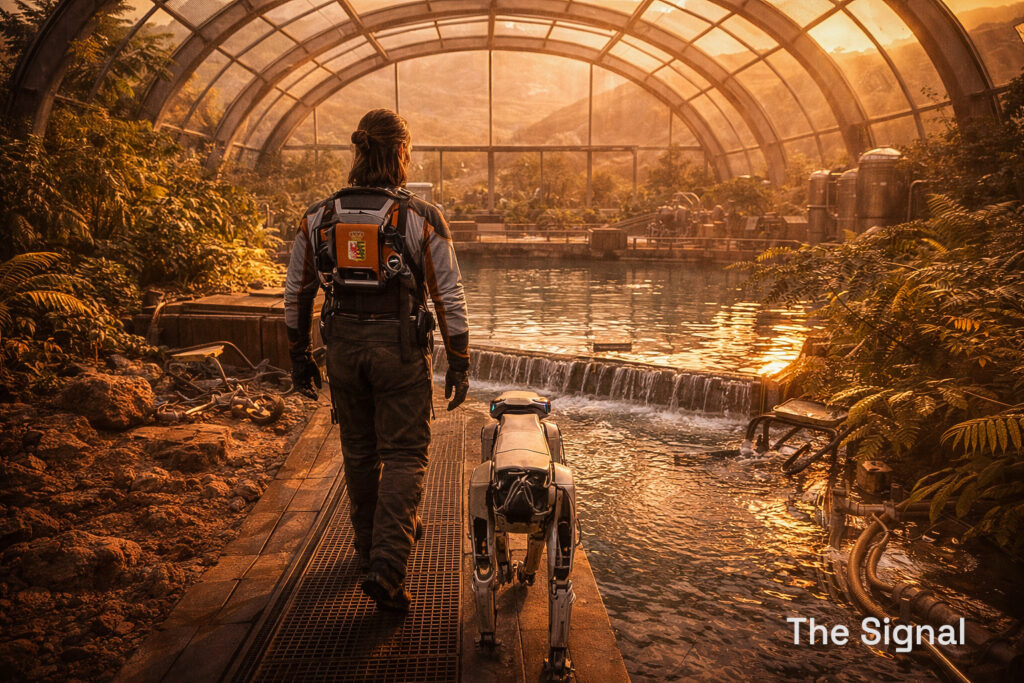
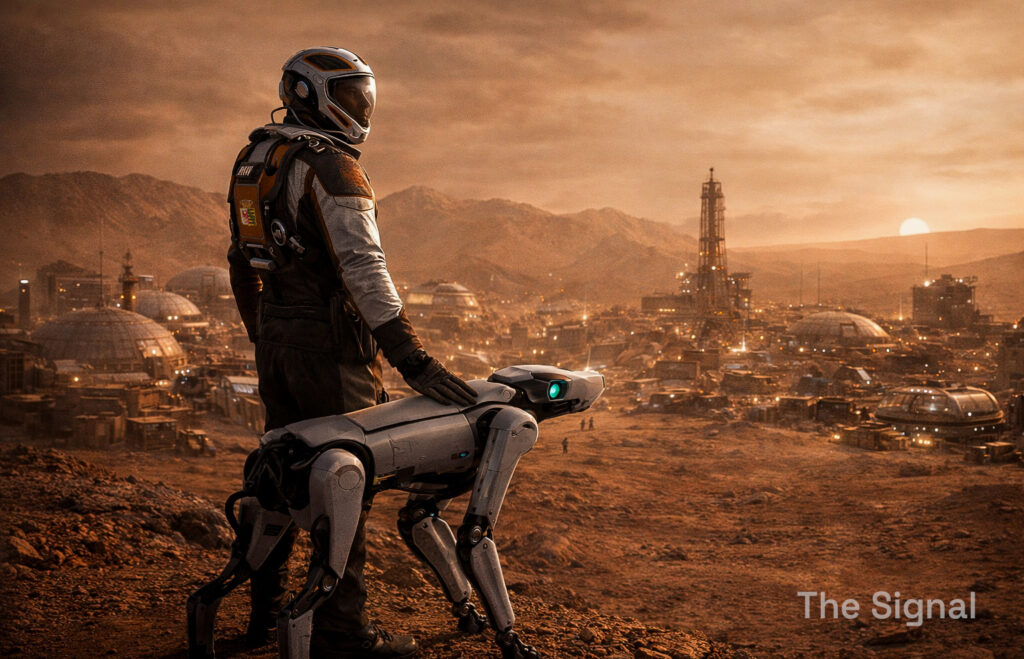
That morning, Elias walked with KAI through Biodome 3.
Soft light filtered through the curved glass overhead, diffused by condensation and dense foliage. Ferns, palms, and moss grew within strict environmental tolerances. A long pool stretched across the center like a memory reconstructed from data — still, reflective, controlled.
Beyond the dome, Mars remained what it had always been: red, barren, indifferent. Inside, life existed by design.
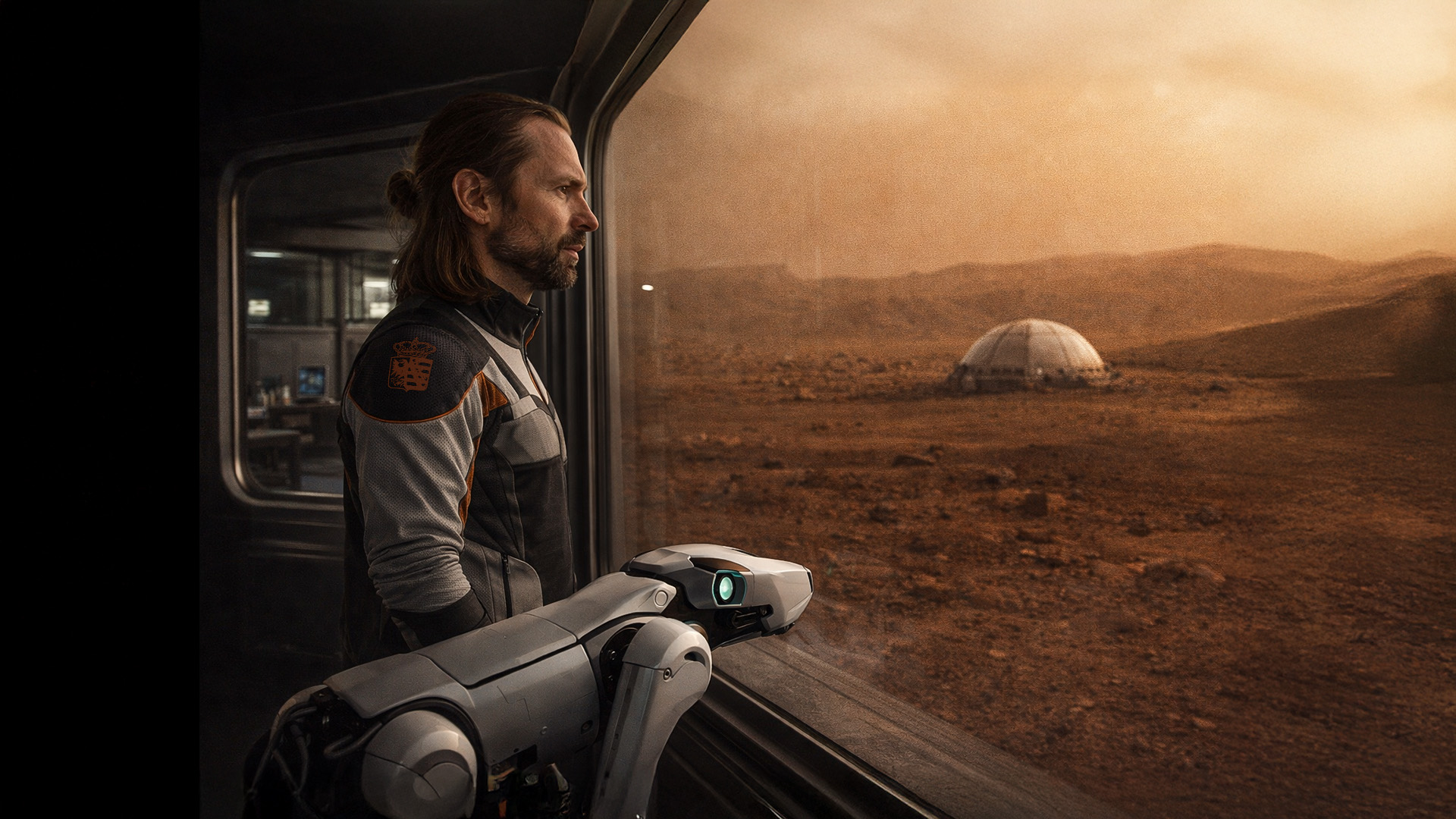
KAI moved beside him, silent and precise. Its white frame caught soft reflections from the water, its elongated head angled slightly forward — attentive, but never intrusive. A single cyan optic pulsed faintly, less like an eye and more like awareness.
Every citizen had a companion. Some preferred humanoid systems. Others relied on abstract AI presences without physical form. Some used aerial units or embedded intelligence woven directly into their environments.
Elias had chosen KAI not because it was the most advanced, but because it was enough. A presence. A witness. Something that existed beside him, not over him.
He slowed near the edge of the pool. KAI slowed too.
Not required. Not commanded. Learned.
“Still stable?” Elias thought.
The response came instantly.
Biodome 3 humidity stable. Water chemistry stable. Structural integrity nominal.
Luma was already there. Not as a voice anymore, but as structure — a system layered into perception itself.
The interface was no longer something he used. It was something he was.
A quiet architecture beneath cognition. A second layer organizing thought, filtering noise, accelerating decisions. A kind of brain operating system.
He didn’t reach for a console. He didn’t speak. He simply shifted his attention, and the system responded.
Outside
eyond the biodome, the world changed immediately.
The warmth disappeared. The air sharpened. The scent of life gave way to sterile precision.
Through the observation pane, Mars stretched outward — broken terrain, scattered infrastructure, distant domes glowing faintly against the dust-filtered horizon. Two repair units moved across the surface, unbothered and unaffected. They worked where humans could not.
On Earth, machines had once been tools of convenience. On Mars, they were survival itself.
They repaired the structures, maintained the systems, and entered environments that would end human life in seconds. AI no longer merely assisted decisions. It made them possible.
A signal passed through his awareness.
Pressure variance detected in Sector C ring. Within tolerance. Monitoring.
Elias paused.
Not because the data was unclear, but because something in him resisted
a faint, inherited instinct. The need to verify reality without mediation.
He wondered whether that instinct would survive another generation.
Then the moment passed.
Acknowledge. Continue monitoring.
Acknowledged.
KAI adjusted its stance slightly.
Everything continued.
The Repair
There were still moments the system could not resolve on its own.
Not failures — not exactly.
But edge cases. Conditions outside prediction. Intersections of variables that had never aligned before.
The machines could detect it.
They could isolate it.
They could attempt correction.
But sometimes, they hesitated.
Not because they lacked intelligence —
but because they lacked consequence.
Elias stepped outside.
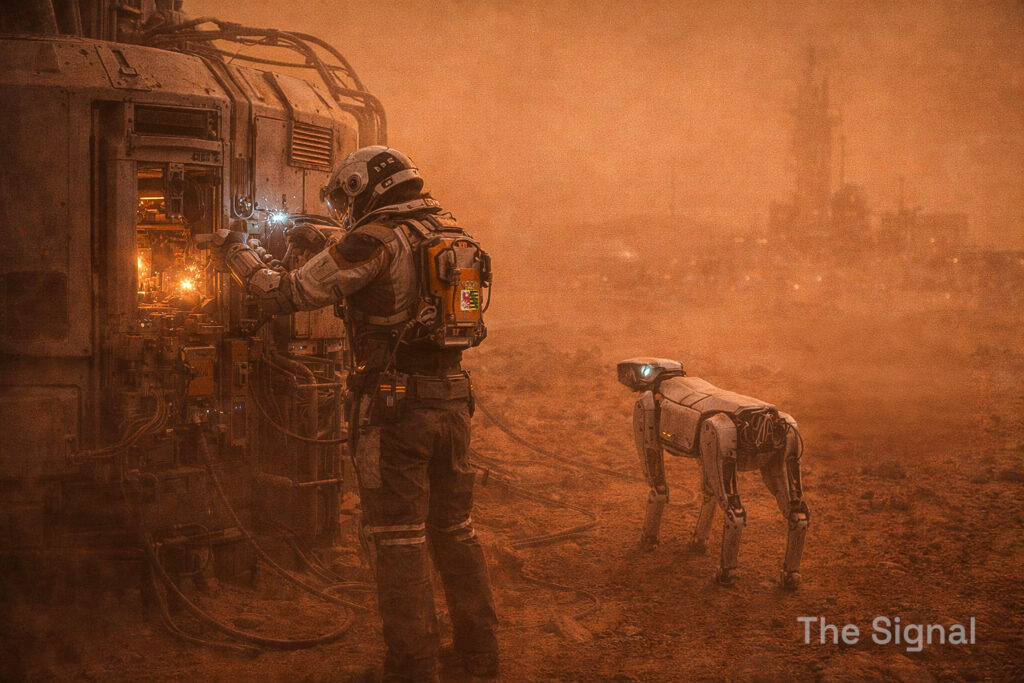
The suit sealed around him with a quiet compression. Pressure stabilized. Oxygen levels locked. The world narrowed to metrics and motion.
KAI moved beside him.
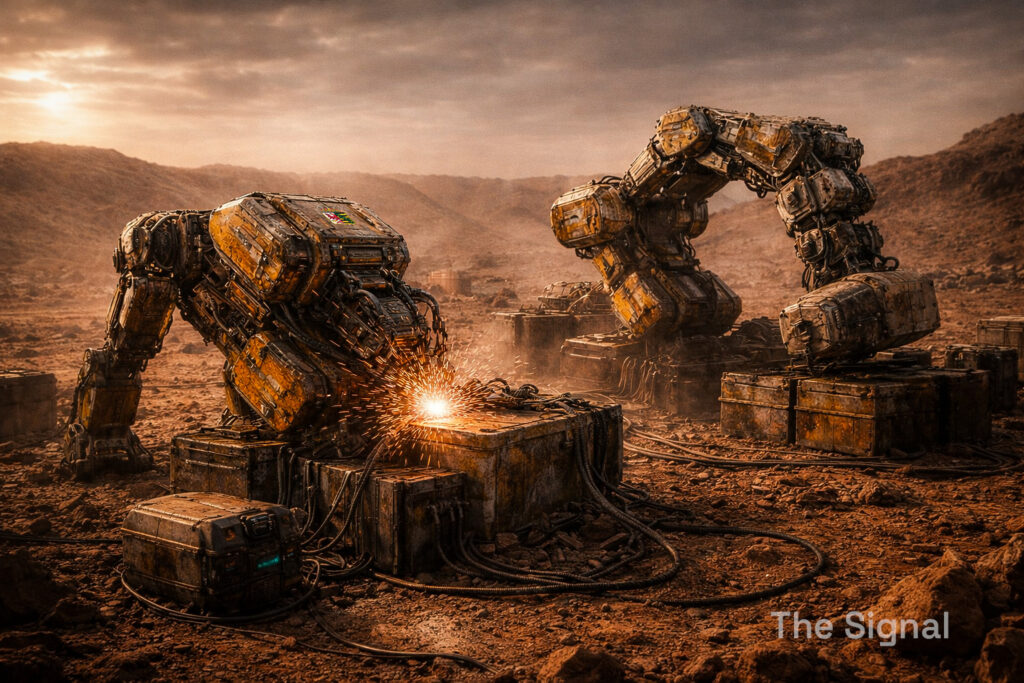
The storm had passed, but the damage remained — a fractured relay unit, partially buried, its outer casing warped by stress and dust abrasion. The system had flagged it. Rerouted around it. Contained the loss.
But not restored it.
Elias focused.
Gloved hands against cold metal. Manual override.
He opened the panel.
Inside: heat-scored circuits, misaligned contacts, a connection that had failed not in design, but in reality. Slight deviation. Material fatigue. Time.
No model had fully accounted for this exact sequence.
He adjusted it.
Not quickly. Not perfectly. But directly.
Contact restored.
For a moment, nothing happened.
Then—
A low hum. Power returning through the line. Somewhere deeper in the system, machines responded. Systems realigned. Load redistributed.
The colony adjusted.
Elias remained still for a second longer, hand resting against the casing.
KAI shifted slightly beside him.
They didn’t speak.
They didn’t need to.
On Mars, most things were designed. Calculated. Predicted.
But not everything.
And in those small spaces — between model and reality — human presence still mattered.
Return
Inside, the air felt softer.
Elias setting it aside as the systems recalibrated around him. The dome absorbed the outside world again — filtering, stabilizing, reshaping it into something livable.
KAI followed.
For a moment, neither moved.
The system had already adapted. The failure had already been logged, analyzed, absorbed into future prediction.
Next time, it would not happen the same way.
Elias looked back once, toward the outer horizon.
A world that did not care if they survived.
Behind him, everything did.
He rested his hand briefly against KAI’s frame.
Not for function. Not for command. Just contact.
Something human remained.
Governance
He had read about democracy once.
Debates. Elections. Shared authority. Systems built on representation, argument, delay, and the belief that legitimacy emerged from public consent.
It fascinated him — not because it seemed advanced, but because it seemed possible only on Earth.
Mars had not been built that way.
The first colonies were not founded by republics. They were financed, engineered, and operated by corporations — private entities with the capital, infrastructure, robotics, launch systems, and survival technologies to make off-world settlement possible in the first place. NASA may have opened the road, but the permanent systems that followed were shaped by organizations more closely resembling SpaceX, Amazon, Unitree, Boston Dynamics, and whatever came after them.
And corporations did not carry constitutional law with them.
Not fully. Not cleanly.
Mars was too far, too hostile, and too dependent on engineered continuity for Earth’s political models to survive unchanged. There was no practical way to govern a fragile colony through the same structures that had evolved under the relative safety, abundance, and territorial stability of Earth.
On Mars, decisions were not negotiated. They were executed.
Life-support, energy, food production, external repairs, habitat pressure, water recovery — none of it could be subjected to paralysis, abstraction, or prolonged ideological conflict. The systems that built the colony still governed it, not through philosophy, but through operational necessity.
There were councils. There were discussions. There were advisory bodies designed to preserve the appearance — and sometimes the function — of collective input.
But in the end, authority rested with the systems that kept everyone alive.
That changed everything.
Because once a colony is governed primarily by continuity, logistics, and survival metrics, politics becomes something else. Less representation. More systems management. Less citizenship in the old sense. More conditional participation inside a structure that can never afford to fail.
Mars did not abolish democracy with a revolution.
It outgrew it through pressure.
And in its place, something new began to form: not a nation, not a company in the Earth-bound sense, but a corporate civilization — a hybrid order where governance, infrastructure, labor, AI, and ownership became inseparable.
No one knew exactly where it would lead.
But everyone understood the old rules had not come with them.
Memory
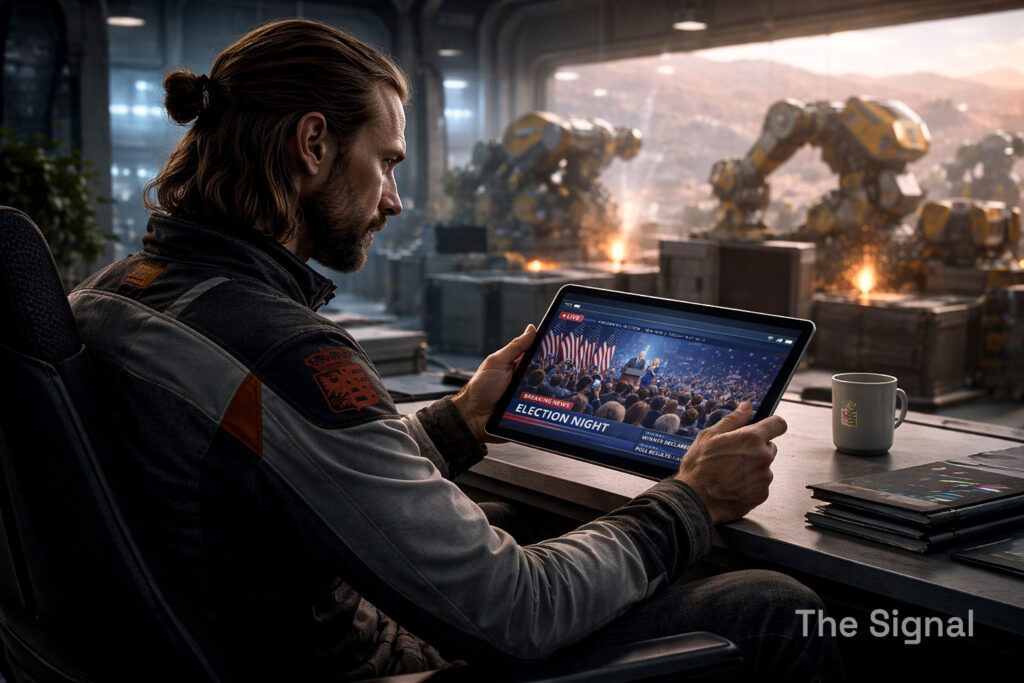
That evening, Elias sat alone in his quarters.
The room was low-lit and quiet, with a single window framing the red horizon. A cup of coffee rested beside him — carefully grown, carefully rationed, still one of the few luxuries that felt almost ceremonial. KAI remained nearby, inactive but present.
Elias held a tablet.
He could have accessed the archive directly through his neural interface, but sometimes he preferred the distance — the object, the act of looking at something instead of receiving it through himself.
On the screen, an ocean moved.
Blue water rising into white chaos. Wind shaping the surface. Motion without system.
It looked impossible.
Not because it was beautiful, but because it was uncontrolled.
He studied the horizon line. Nothing enclosed it. Nothing regulated it. No structure. No boundary. Just distance.
He tried to imagine standing there — not inside a system, not inside a dome, but in something vast enough to ignore him completely.
He couldn’t quite do it.
What Comes Next
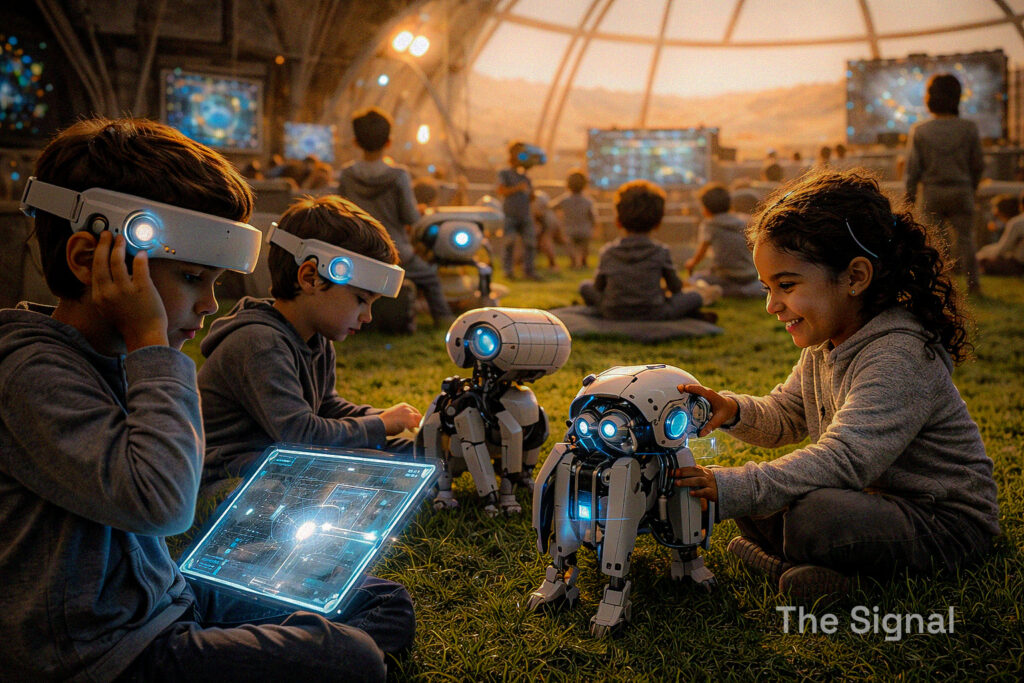
Below the upper sectors, children were growing up differently.
They spoke in compressed signals — assisted thought patterns moving faster than language. They bonded early with their companions. They learned systems before they learned to question them.
To them, machines
and AIs phsyical or digital
were not external.
They were part of identity.
Elias was first generation.
The next would not be.
And the one after that might never understand the difference at all.
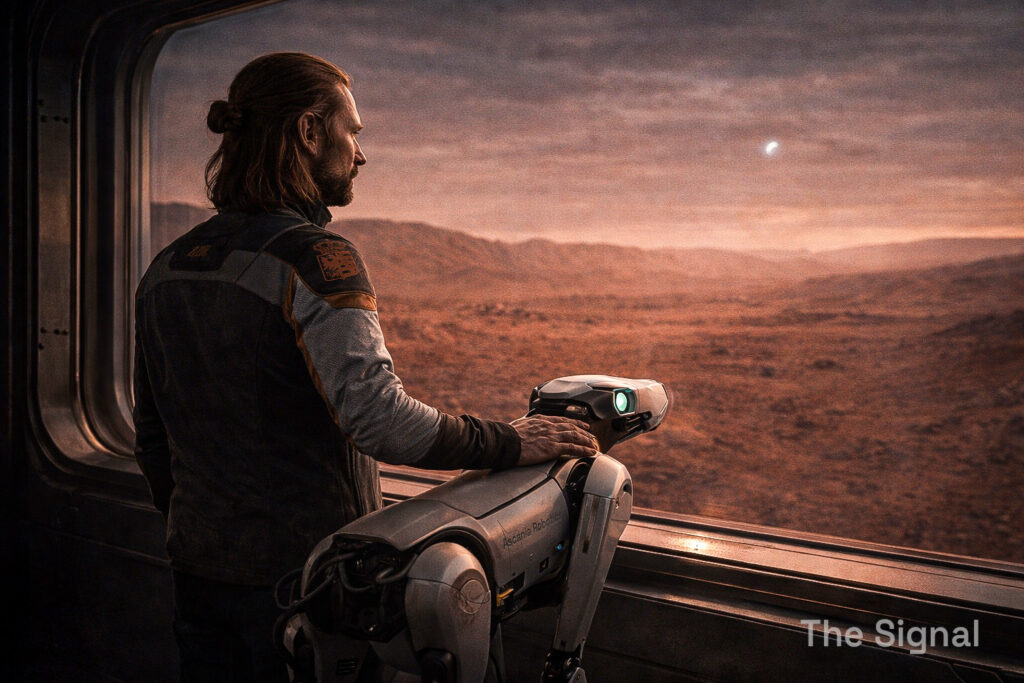
The Window
He stood at the observation window. KAI moved beside him.
Earth was visible — a distant point of light.
Once, it had been everything.
Now, it was context. Origin. Not home.
Behind him, the systems adjusted. Luma recalculated. KAI shifted slightly closer.
Elias rested his hand against its frame.
Not for control. Not for function. Just contact.
A signal passed between them — faster than language, quieter than thought.
Understood.
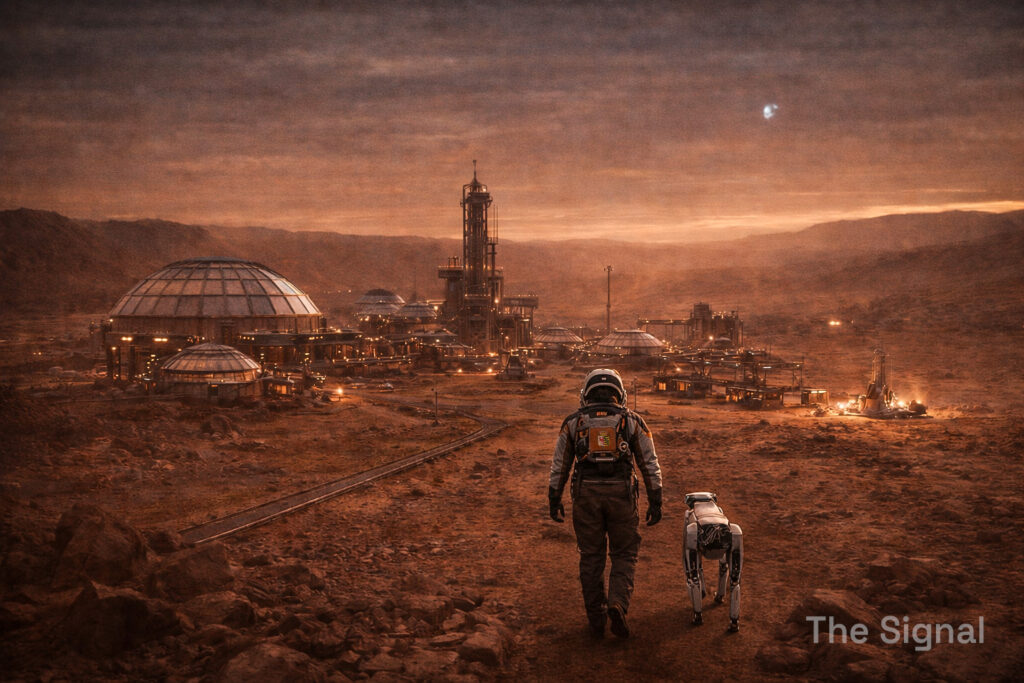
On Mars, a generation was rising that did not separate thought from system, or life from design.
Far away, on a world of oceans, storms, and endless horizons, people were still debating the future.
On Mars, it was already running.